A new Juvenile Law Bulletin, Transfer of Juvenile Delinquency Cases to Superior Court, is now available. Transfer is the procedure used to move a case that begins as a delinquency matter under the original jurisdiction of the juvenile court to criminal court for trial as an adult. The Bulletin outlines when transfer is allowed, and sometimes required; the varying procedures to use to transfer a case based on age at offense and the offense charged; procedure to follow once transfer is ordered; the remand process; place of confinement; and issues related to the appeal process. This blog provides some highlights of the information in the Bulletin.
Transfer Procedure Depends on Age at Offense and Offense Charged
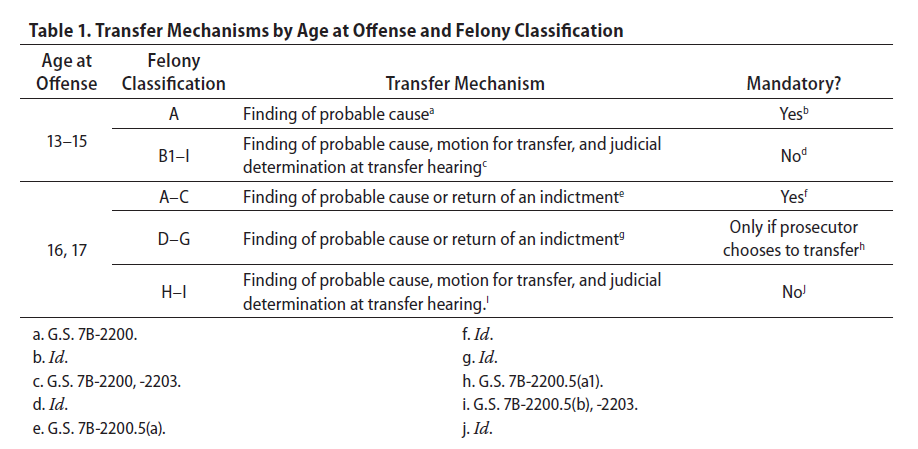
Whether transfer is allowed at all, discretionary, or mandatory varies based on age at offense and the offense charged. The table below provides a summary of the various rules that apply to cases that are subject to transfer. Cases in which the offense is alleged to have occurred when the juvenile was under the age of 13 or cases that include only misdemeanor charges are never subject to transfer. As described in a previous blog, once one offense is transferred, superior court obtains jurisdiction over the entire transaction. G.S. 7B-2203(c). Therefore, only one transfer mechanism needs to be used in each case, even if the offenses that are charged are subject to different transfer mechanisms.
The Bulletin provides additional detail regarding the procedures that apply to the various transfer mechanisms—a finding of probable cause, a true bill of indictment, and a transfer hearing.
Procedure When Ordering Transfer
The Bulletin provides detailed information about the procedures that must be followed when ordering transfer, with links to the appropriate forms to use.
Forms
The forms referenced in the Bulletin to be used in applicable transfer proceedings include:
- form AOC-J-343, Juvenile Order—Probable Cause Hearing, to be used to order transfer following a finding of probable cause;
- form AOC-J-444, Juvenile Order—Transfer After Bill of Indictment, to be used to order transfer following a finding that a qualifying indictment has been returned;
- form AOC-J-442, Juvenile Order—Transfer Hearing, to be used to order a discretionary transfer following a transfer hearing; and
- form AOC-CR-922, Release Order for Juvenile Transferred to Superior Court for Trial.
Content of Discretionary Transfer Orders
There is caselaw that provides direction regarding the necessary content of transfer orders issued as the result of a transfer hearing. See State v. Green, 124 N.C. App. 269 (1996), In re E.S., 191 N.C. App. 568, 572–73 (2008), and In re J.L.W., 136 N.C. App. 596, 600–01 (2000). Discretionary transfer orders must specify the reasons for transfer and reflect that the court considered all eight factors as required by G.S. 7B-2203(b). At the same time, discretionary transfer orders are not required to contain findings of fact to support the court’s conclusion that the needs of the juvenile or the protection of the public would be served by transfer.
Other Requirements and Considerations After Ordering Transfer
Pretrial Release. Once transfer is ordered, a juvenile has the right to pretrial release under Article 26 of the North Carolina Criminal Procedure Act. G.S. 7B-2204. The Bulletin details how the shift from juvenile to criminal jurisdiction means that the youth can no longer be detained pursuant to a secure custody order once the matter is under the jurisdiction of the superior court. When determining conditions of pretrial release following transfer, the district court must
- follow the provisions of S. 15A-533 and G.S. 15A-534, and
- specify the person or persons to whom the juvenile may be released. S. 7B-2204(a).
Fingerprints and DNA. G.S. 7B-2201 requires that juveniles be fingerprinted and, if charged with an offense subject to the DNA sample requirement, provide a DNA sample when jurisdiction is transferred to superior court.
Counsel. Transfer of a case from juvenile to criminal jurisdiction may result in the need to appoint a new attorney to represent the youth. At the same time, there are important rights that the youth has immediately after transfer, including the right to appeal to the superior court and the right to pretrial release. The Bulletin explores these issues and suggests that district courts routinely inquire about ongoing representation for youth at the time of transfer to ensure that these rights are protected.
Place of Confinement
If youth remain confined following transfer, the place of confinement depends on the age of the youth. As long as youth remain under age 18, they must be housed in a juvenile detention facility. Once the youth turn 18, they must be transferred to the sheriff in the county where the charges arose for confinement in the jail. G.S. 7B-2204(a), (c).
Remand
When a case that alleges an offense committed at age 16 or 17 is transferred, it can be returned to district court to be handled as a juvenile matter through the remand process. The district attorney and the juvenile’s attorney must file a joint motion to the superior court for remand. G.S. 7B-2200.5(d). Form AOC-CR-291 should be used for this purpose. Once the joint motion is filed, the superior court must remand the case. The superior court record must be expunged on remand, including any DNA record or profile included in the state DNA database and any DNA sample stored in the state DNA databank as a result of the remanded charges. G.S. 15A-145.8. Form AOC-CR-292 should be used for expunction under these circumstances.
In order to hold the youth in custody following remand, a new secure custody order must be issued. The superior court has authority to issue a secure custody order in accordance with G.S. 7B-1903 when remanding a case. Session Law 2021-123, §§ 3.(a)-(b).
Appeals
The Juvenile Code provides a right to an interlocutory appeal of every transfer order. G.S. 7B-2603(a). The intersection of this right to an appeal and the right to confidentiality in juvenile matters provided under the Juvenile Code has led to significant confusion regarding how to handle matters during this appeal period. I addressed this in a previous blog. The Bulletin also discusses these issues in-depth, including that
- the Rules of Recordkeeping (12.8.1 and 12.8.2) provide confidentiality protections in case the youth wins the appeal and the matter is returned to district court as a juvenile matter, including that the case should not be entered into the Automated Criminal Information System before the appeal is resolved,
- a CRS number should be manually generated for use on the associated criminal forms (such as the AOC-CR-922, used to order conditions of pretrial release upon transfer), and
- any issues that may arise during the appeal period should be addressed by the superior court as the superior court has jurisdiction over the matter during this time.
The superior court must review the record of the transfer hearing for abuse of discretion if an interlocutory appeal is timely filed. The superior court may not review any finding of probable cause for the underlying offense. G.S. 7B-2603(a).
Exercising the right to this interlocutory appeal preserves the right to appeal the transfer to the Court of Appeals. However, as discussed in the Bulletin, that right to appeal can only be exercised if the youth is found guilty in superior court following a trial. G.S. 7B-2603(d).
Additional Resources on the Horizon
There have been several changes to the Juvenile Code since passage of the original raise the age legislation. This Bulletin reflects the law as of January, 2022. I am also working on a second edition of the Juvenile Justice Reinvestment Act Implementation Guide to accurately reflect current law. Please feel free to let me know if there are other resources that would be helpful to you in your delinquency work. As always, you can reach me at greene@sog.unc.edu.